













Summer is coming.
And if you’re reading this, you already know it’s coming faster than you’d like.
Maybe you’ve been putting off the gym. Maybe you’ve tried before and didn’t get the results you wanted. Maybe you just want to feel genuinely good in your own skin this year — not just okay, not just “fine for my age” — but actually confident. Actually proud.
Here’s the thing: that feeling is closer than you think.
You don’t need to spend hours in the gym. You don’t need to punish yourself into shape. What you need is a smart, targeted plan — one that burns fat, builds lean muscle, and has you feeling genuinely good in your own skin before summer even starts.
That’s exactly what this guide gives you.
What a “Summer Body Workout” Actually Means
Let’s clear something up first.
A summer body workout is not about crash dieting, two-a-day training sessions, or punishing yourself for every meal you enjoyed over winter. That approach doesn’t work. In fact, research consistently shows that extreme caloric restriction combined with excessive exercise leads to muscle loss, hormonal disruption, and rebound weight gain — the exact opposite of what you want.
Source: NIH — Caloric Restriction and Muscle Loss
What actually works is a combination of two things: progressive strength training to build and preserve lean muscle, and strategic cardio to accelerate fat loss. When you do both consistently — and pair them with smart nutrition — your body changes. Not overnight. But faster than most people expect.
Here’s what the science says about timelines: with consistent training and a modest caloric deficit, most people can lose one to two pounds of fat per week while maintaining or building lean muscle. Over six to eight weeks, that adds up to a visible, meaningful transformation.
That’s the goal. And it’s completely achievable.
The Four Pillars of a Summer Body Workout Plan
Before we get into specific exercises and weekly plans, you need to understand the four pillars that every effective summer body program is built on. Skip any one of them and your results will be slower, harder, and less satisfying.
Pillar 1 — Strength Training
Strength training is the foundation of a lean, toned physique. Not because it burns the most calories during the workout — it doesn’t — but because it builds lean muscle tissue, which raises your resting metabolic rate and changes the shape of your body in ways that cardio alone never can.
The goal here is not to get bulky. It’s to get defined. And the only way to get defined is to have muscle underneath the fat you’re burning. Without it, you lose weight but still feel soft. With it, you look lean, strong, and athletic.
Aim for three to four strength sessions per week, targeting all major muscle groups.
Pillar 2 — Cardio, Done Right
Cardio is valuable — but most people do too much of the wrong kind. Long, slow, steady-state cardio burns calories during the session but does little to elevate your metabolism afterward. High-intensity interval training, or HIIT, burns fewer calories during the session but triggers a significant post-exercise calorie burn that can last up to 24 hours.
Source: Journal of Obesity — HIIT and Fat Loss
The sweet spot for summer body results is two to three HIIT sessions per week, with one longer steady-state session for active recovery and cardiovascular health.
Pillar 3 — Mobility and Recovery
This is the pillar most people skip. And it’s the one that quietly determines whether you stay consistent or burn out.
Mobility work — stretching, foam rolling, yoga, or even a 10-minute walk — reduces soreness, prevents injury, and keeps your joints healthy enough to train hard week after week. Without it, you’ll hit a wall around week three or four and wonder why your body feels broken.
Schedule at least one dedicated recovery day per week. Your results will actually improve.
Pillar 4 — Nutrition Alignment
You cannot out-train a bad diet. That’s not a cliche — it’s physiology.
A single fast food meal can contain more calories than an entire hour of intense exercise burns. Nutrition doesn’t have to be complicated, but it does have to be intentional. More on this shortly.
The Best Exercises for a Summer Body
Now let’s get specific. Here are the most effective exercises for each major goal area — the ones that deliver the most visible results in the shortest time.
For a Flat, Defined Stomach
The most effective core exercises are not crunches. They’re compound movements that engage the entire core under load — planks, dead bugs, hanging leg raises, cable woodchops, and ab wheel rollouts. Pair these with a caloric deficit and the definition will follow.
The truth about abs is simple: everyone has them. The goal is to reduce the body fat covering them. Targeted core work builds the muscle. Nutrition and cardio reveal it.
For Toned Arms and Shoulders
The exercises that create the most visible arm and shoulder definition are overhead pressing movements (dumbbell shoulder press, Arnold press), pulling movements (rows, lat pulldowns, face pulls), and direct arm work (bicep curls, tricep dips, skull crushers).
Women often avoid heavy upper body work out of fear of getting bulky. That fear is unfounded. Women have significantly lower testosterone levels than men, which makes it physiologically very difficult to build large muscle mass. What heavy upper body training actually does is create the lean, defined look most women are after.
For Sculpted Glutes and Legs
The lower body responds fastest to training — and the exercises that produce the most dramatic results are squats, Romanian deadlifts, hip thrusts, Bulgarian split squats, and walking lunges.
Hip thrusts in particular are one of the most underused exercises for glute development. Research from the Journal of Strength and Conditioning Research found that hip thrusts produce significantly greater glute activation than squats alone.
Source: Journal of Strength and Conditioning Research — Hip Thrust vs. Squat
For Maximum Full-Body Fat Burn
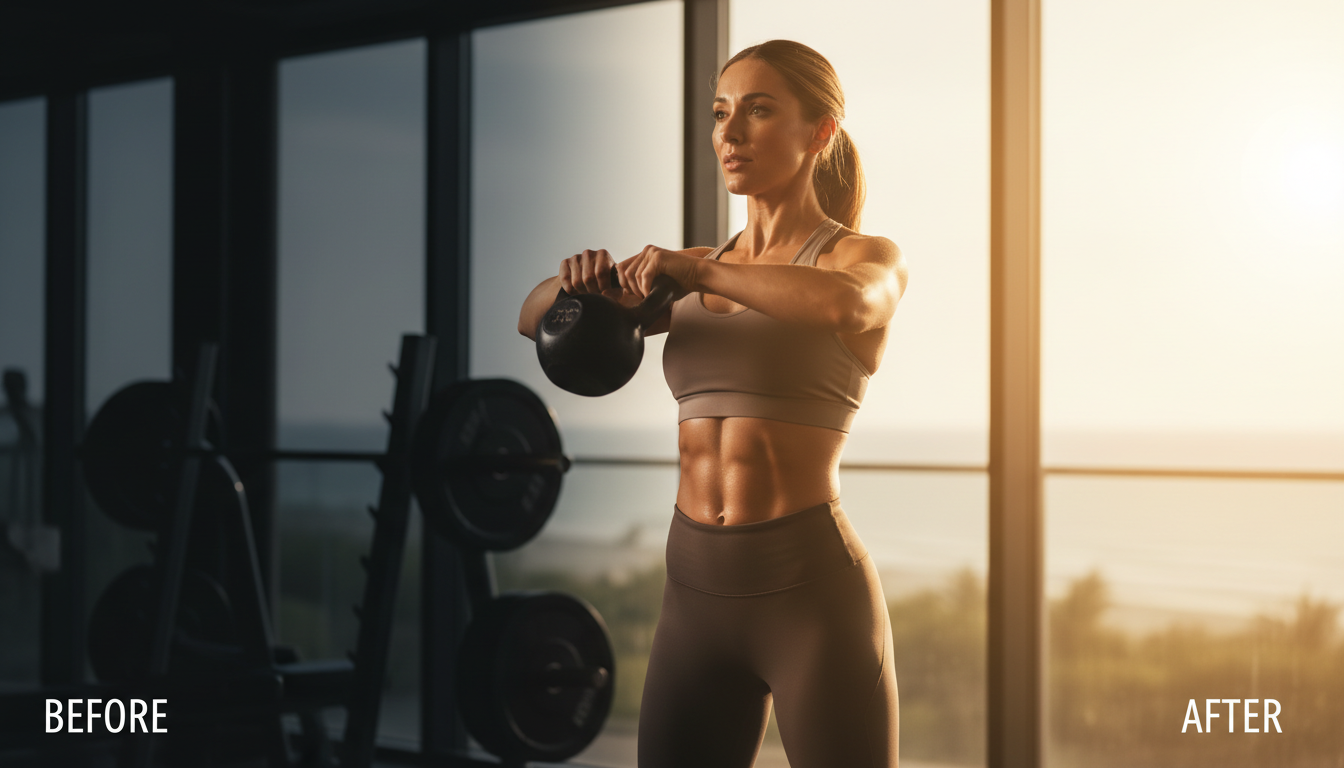
The exercises that burn the most calories and engage the most muscle groups simultaneously are compound movements: deadlifts, barbell squats, kettlebell swings, burpees, and clean and press variations. These are the backbone of any effective fat-loss program.
The 6-Week Summer Body Workout Plan
Here is a structured, progressive six-week plan designed to build lean muscle, accelerate fat loss, and peak your results right as summer arrives.
Weeks 1–2 — Build the Base
The first two weeks are about form, consistency, and muscle activation. Do not rush this phase. The goal is to establish movement patterns, wake up underused muscles, and build the habit of showing up.
Train four days per week: two lower body sessions, two upper body sessions. Keep intensity moderate — around 65–70% of your maximum effort. Focus on feeling the right muscles working.
Weeks 3–4 — Increase Intensity
Now you add progressive overload. Increase weights by five to ten percent. Add one set to each exercise. Introduce two HIIT cardio sessions per week, 20–25 minutes each.
This is where most people start to see visible changes. The combination of increased training load and cardio creates a meaningful caloric deficit while preserving and building lean muscle.
Weeks 5–6 — Peak Phase
The final two weeks are your peak phase. Training intensity is at its highest. Cardio frequency increases to three sessions per week. Nutrition becomes more precise.
This is also the phase where the results become most visible. The combination of reduced body fat and increased muscle definition creates the lean, athletic look that most people associate with a summer body.
Track your progress with photos and measurements — not just the scale. The scale doesn’t distinguish between fat and muscle. Photos and measurements do.
Summer Body Workouts at Home — No Gym Required
Here’s something most people don’t realize: you don’t need a gym to get a summer body.
Bodyweight training, when programmed correctly with progressive overload, produces results that rival gym-based training. The key is progression — making the exercises harder over time by adding reps, reducing rest periods, or moving to more challenging variations.
The only equipment worth investing in for home training is a set of resistance bands (around $20–$30) and a pair of adjustable dumbbells. Everything else is optional.
A complete home workout for fat loss and toning looks like this:
Warm-up: 5 minutes of jumping jacks, arm circles, and leg swings.
Circuit 1 (repeat 3 times): Bodyweight squats (15 reps), push-ups (10–15 reps), reverse lunges (12 reps each leg), plank hold (45 seconds).
Circuit 2 (repeat 3 times): Glute bridges (20 reps), dumbbell rows (12 reps each arm), lateral band walks (15 steps each direction), mountain climbers (30 seconds).
Finisher: 10 minutes of HIIT — 30 seconds on, 30 seconds off, alternating between burpees, high knees, and jump squats.
Total time: 45–50 minutes. No gym required.
Summer Body Workouts at the Gym — Making Every Session Count
If you do have access to a gym, here’s how to use it effectively.
The biggest mistake people make in the gym when training for summer is spending too much time on isolation exercises — bicep curls, leg extensions, cable flyes — and not enough time on compound movements. Isolation exercises have their place, but they should be the finishing touch, not the foundation.
Structure every gym session like this: start with one or two heavy compound movements (squat, deadlift, bench press, row), then move to accessory work targeting specific muscle groups, then finish with core work and cardio if needed.
As for the machines vs. free weights debate — free weights win for building functional strength and muscle definition. Machines are useful for isolation work and for beginners learning movement patterns. Use both, but prioritize free weights.
Cardio for a Summer Body — What Actually Works
Let’s settle the HIIT vs. steady-state debate once and for all.
HIIT burns more total calories over a 24-hour period due to the afterburn effect (excess post-exercise oxygen consumption, or EPOC). Steady-state cardio is easier to recover from and better for cardiovascular health. Both have a place in a summer body program.
The optimal cardio prescription for summer body results is two to three HIIT sessions per week (20–30 minutes each) plus one longer steady-state session (30–45 minutes). That’s it. More than that and you risk overtraining, elevated cortisol, and muscle loss — all of which slow your results.
Source: Journal of Sports Sciences — EPOC and HIIT
Nutrition Basics That Supercharge Your Results
Training is the stimulus. Nutrition is the environment in which your body responds to that stimulus.
Get the nutrition wrong and the training produces a fraction of the results it should. Get it right and the results accelerate dramatically.
Here are the fundamentals:
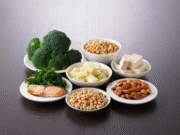
Protein: Aim for 0.7–1 gram of protein per pound of bodyweight per day. Protein preserves lean muscle during a caloric deficit, supports recovery, and keeps you fuller for longer. Prioritize chicken, fish, eggs, Greek yogurt, cottage cheese, and legumes.
Source: American Journal of Clinical Nutrition — Protein and Body Composition
Caloric deficit: A deficit of 300–500 calories per day produces steady fat loss without triggering the muscle-wasting effects of extreme restriction. Use a TDEE calculator to find your maintenance calories, then subtract 300–500.
Pre-workout nutrition: A small meal containing carbohydrates and protein 60–90 minutes before training fuels performance and reduces muscle breakdown. A banana with Greek yogurt or oatmeal with a scoop of protein powder both work well.
Post-workout nutrition: Consume protein within 30–60 minutes after training to support muscle repair and recovery. A protein shake, Greek yogurt, or a chicken and rice meal all work.
What to avoid: Refined sugar, alcohol, and ultra-processed foods spike insulin, promote fat storage, and undermine recovery. You don’t have to be perfect — but consistency matters more than any single meal.
Summer Body Workouts for Beginners
If you’re new to exercise, here’s the most important thing to know: beginners see the fastest results.
Your body is highly responsive to new training stimulus. The first eight to twelve weeks of consistent training produce more visible change than almost any other period in your fitness journey. That’s not motivation talk — it’s exercise science. It’s called “newbie gains,” and it’s real.
Start with three full-body sessions per week. Focus on learning the fundamental movement patterns: squat, hinge, push, pull, and carry. Keep intensity moderate and prioritize consistency over intensity.
The most common beginner mistake is doing too much too soon. Soreness is not a measure of progress. Consistency is. Show up three times a week, every week, for eight weeks — and the results will speak for themselves.
Summer Body Workouts for Women
Women’s bodies respond to training differently than men’s — and understanding those differences makes your program significantly more effective.
The most important difference is hormonal. Women have lower testosterone and higher estrogen levels, which means they build muscle more slowly than men but recover faster between sessions. This makes higher training frequency — four to five sessions per week — particularly effective for women.
The best workout split for women targeting summer body goals is an upper/lower split or a push/pull/legs split, with glute-focused lower body sessions twice per week. Hip thrusts, Romanian deadlifts, and Bulgarian split squats should be staples.
And let’s address the myth directly: lifting heavy weights will not make women bulky. It will make them lean, defined, and strong. The women who look “bulky” from training are typically using anabolic steroids or have been training at elite levels for many years. For the vast majority of women, heavy strength training produces exactly the aesthetic they’re after.
Summer Body Workouts for Men
For men, the summer body goal is typically a combination of lean muscle and reduced body fat — the athletic, defined look rather than maximum size.
The most effective approach is a push/pull/legs split, training five to six days per week with two cardio sessions. Prioritize compound movements — bench press, deadlift, squat, overhead press, barbell row — and use isolation work to target lagging muscle groups.
To cut body fat without losing muscle, maintain a moderate caloric deficit (300–500 calories below maintenance), keep protein high (at least 1 gram per pound of bodyweight), and continue training heavy. The biggest mistake men make when cutting is reducing training intensity. Keep the weights heavy. The deficit handles the fat loss.
On supplements: creatine monohydrate is the most well-researched performance supplement available and is worth considering. Protein powder is a convenient way to hit daily protein targets. Everything else is largely optional.
Source: International Society of Sports Nutrition — Creatine
Sample Full Week of Summer Body Workouts
Here is a complete sample week you can copy and use immediately.
Monday — Lower Body Strength: Barbell squats (4×8), Romanian deadlifts (3×10), hip thrusts (3×12), walking lunges (3×12 each leg), leg press (3×15), calf raises (3×20).
Tuesday — Upper Body Strength: Bench press (4×8), barbell rows (4×8), overhead press (3×10), lat pulldown (3×12), dumbbell curls (3×12), tricep dips (3×12).
Wednesday — Active Recovery: 30-minute walk, 10 minutes of stretching, foam rolling.
Thursday — Full Body HIIT: 5-minute warm-up, then 6 rounds of: kettlebell swings (15 reps), push-ups (10 reps), box jumps (10 reps), battle ropes (30 seconds). Rest 60 seconds between rounds.
Friday — Upper Body Strength and Core: Incline dumbbell press (4×10), cable rows (4×10), face pulls (3×15), Arnold press (3×12), ab wheel rollouts (3×10), hanging leg raises (3×12).
Saturday — Longer Cardio or Outdoor Activity: 45-minute run, bike ride, swim, or hike. Keep intensity moderate — this is active recovery, not punishment.
Sunday — Rest: Full rest. Sleep, eat well, and let your body recover and rebuild.
How to Stay Motivated All the Way to Summer
Here’s the truth about motivation: it fades. Every single time.
The people who get results are not the ones who feel motivated every day. They’re the ones who show up even when they don’t. They’ve built a system — a schedule, a habit, an identity — that doesn’t depend on how they feel on any given morning.
The most powerful shift you can make is to stop thinking of yourself as someone who is trying to get fit and start thinking of yourself as someone who trains. That identity shift changes everything. It makes skipping a workout feel wrong instead of normal.
Track your progress with weekly photos, body measurements, and performance metrics — how much you lifted, how fast you ran, how many reps you completed. These numbers tell a more accurate story than the scale, and they give you concrete evidence that the work is paying off.
And when you miss a week — because life happens — don’t restart from zero. Just pick up where you left off. One missed week does not undo six weeks of consistent work. What undoes it is the decision to quit.
FAQ — Summer Body Workouts Answered
How many weeks does it take to get a summer body?
Most people see meaningful visible changes within four to six weeks of consistent training and smart nutrition. A full transformation — the kind that turns heads — typically takes eight to twelve weeks. Start now.
Can I get a summer body working out just three days a week?
Yes. Three full-body sessions per week, done consistently with progressive overload and proper nutrition, produce significant results. It’s not the maximum — but it’s far more than most people are currently doing.
Is it better to work out in the morning or evening?
The best time to work out is the time you will actually do it consistently. Research shows no meaningful difference in fat loss or muscle gain between morning and evening training. Consistency beats timing every time.
What if I only have 20–30 minutes a day?
Twenty to thirty minutes of focused, high-intensity training is more than enough to produce results. A 25-minute HIIT session or a focused strength circuit delivers significant stimulus in a short window. The key is intensity and consistency.
Do I need supplements to get results?
No. Whole food nutrition handles the vast majority of your needs. Protein powder is a convenient supplement if you struggle to hit daily protein targets. Creatine monohydrate is worth considering for performance. Everything else is optional.
The Bottom Line
A summer body is not a fantasy. It’s not reserved for people with perfect genetics, unlimited time, or a personal trainer.
It’s the result of a smart plan, executed consistently, over six to eight weeks.
You have the plan now. You know the exercises, the structure, the nutrition principles, and the mindset. The only thing left is the decision to start — and the commitment to keep going when it gets hard.
Summer is coming. And this year, you’ll be ready.
Sources and Further Reading
- NIH — Caloric Restriction and Muscle Loss
- Journal of Obesity — HIIT and Fat Loss
- Journal of Strength and Conditioning Research — Hip Thrust vs. Squat
- Journal of Sports Sciences — EPOC and HIIT
- American Journal of Clinical Nutrition — Protein and Body Composition
- International Society of Sports Nutrition — Creatine